|
FlyFish GA
FLINT RIVER SHOAL BASS - CHATTAHOCHEE STRIPERS -
LARGEMOUTH BASS & BREAM LAKES - GAR & CARP |
|
Home Fishing Reports Locations & Species Tackle & Tactics Fly Box Guided Trips More |
|
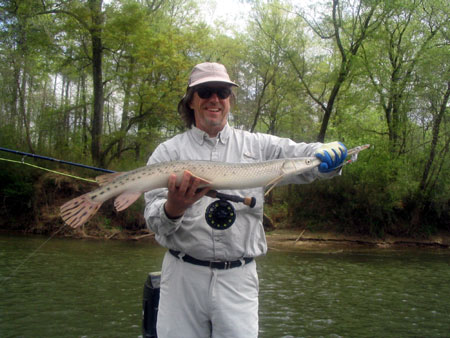
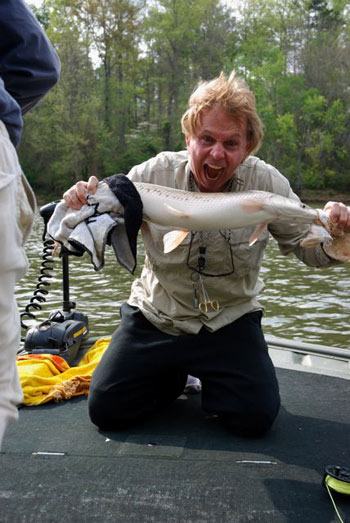
It's a Game Fish...... Disparagingly dismissed by many anglers as a "trash" fish, the longnose gar is, in fact, a hard fighter that is more than willing to take a fly. And they are actually quite pretty fish, with leopard spots, opalescent scales and pinkish tails. If these fish don't get your adrenaline pumping, you're probably better off just grabbing your phone and checking your mail!
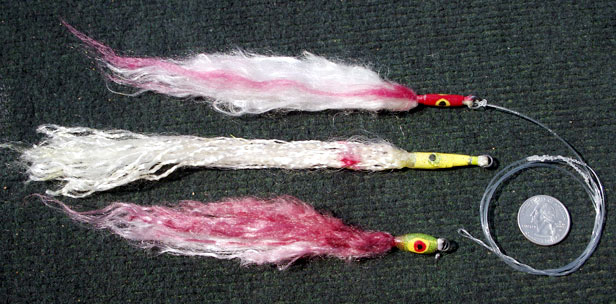
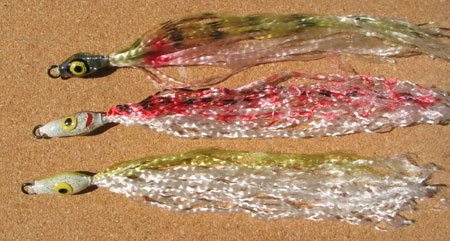
Gar Flies The problem with gar is that their mouth is mainly bone and teeth and even the sharpest hook will seldom penetrate. The solution is the rope fly, tied with nothing but some slightly unbraided nylon rope and maybe a little flash. The gar mouths the fly and the nylon becomes tangled in its fine teeth. Resist the temptation to set the hook - give the fish slack immediately and let him shake his head several times before you tighten up.
The
bottom fly
of the first photo is a veteran
of several fish; the others are new. I use
1/4" nylon rope,
pull out the center core and unbraid the individual strands. The fly is
tied on
a small stainless ring (available from
FeatherCraft)
with
one
section
of rope (doubled) per fly.
Insert the
nylon strands (twice the length of the finished
fly), and
flash if desired, through the ring
I prefer my flies 7-9" long. This makes them a bit hard to throw using lighter rods, but the longer length "hooks" better. Rods in the 7-weight to 9-weight range make these flies much easier to throw. I sometimes cut-down flies to carry when fishing lighter rods, but my hook-up ratio is lower.
Though some people use them, I've never found wire leaders necessary for gar. In fact, with the rope flies, I often catch them without any kind of "bite" or "shock" tippet. My standard rig is usually a 7-9' leader with 12-16lb tippet, and about a 6" bite tippet of 30-lb mono. I use the non-slip mono loop to attach the fly.
"Hooking" The Fish Gar fishing is often "sight-fishing". The fish spend a lot of time on or near the surface and the angler can often spot the fish before the cast. Gar are often seen "porpoising" slowly on the surface - when acting this way, they may or may not be feeding. At times, they will be aggressively slapping at bait near the surface - this is typically feeding activity. Especially in warm weather, you may see the fish just hanging motionless on or near the surface - this is sometimes a resting pose, but it can also be a camouflaging maneuver. The gar will hold, looking like a floating stick, and then flash into action when an unsuspecting baitfish nears. In most cases, the gar will actually ease up with his snout parallel to the prey fish. The, with a sudden sideways twist of the head, he'll nail the bait. They seem to prefer striking with the center section of their jaws rather than taking frontally - this is probably because the incapacitate the prey before trying to swallow it.
Tactics for getting the gar to eat the fly will vary. My most-used technique is a slow, erratic movement of the fly. I try to throw as you normally would when sight-fishing, leading the fish in a direction so that my retrieve intersects his path without swimming toward him. Sometimes when the gar are actively feeding, a fast retrieve will trigger a strike. Generally, the slow technique brings the most hits for me.
The slow
strip method offers another considerable advantage. Ironically,
considering its vicious-looking mouth full of teeth, the gar's strike is
often quite subtle. Perhaps with all those sharp teeth, he
only needs to bite lightly on his normal prey. His bite is not to
kill, injure or incapacitate the bait, but rather just to catch.
With a fast strip, it is quite easy to pull the fly right out of the
gar's mouth (before the nylon tangles). In fact, if you don't see
the take, it may feel like nothing more than a very light tap or bump.
It is critically important that you give the fish slack immediately.
With no tension, the fly has a much better chance of tangling in the
teeth. I like to let the fish run for 20-30', hopefully feeling
several head shakes in the process. Only then will I tighten up on the
line. And make sure you just tighten up, no hard hook set.
At times you will see the fish on top and then they will submerge and you lose sight. A sinking or sink-tip line can be useful in times like this. Cast in the general direction and fish very slowly, with regular hesitations. The big fly has good visibility, and you'll often draw a hit from an unseen fish. Here especially you must be alert for the slightest bump and immediately "dead-stick" the fly.
Landing & Releasing The Gar
Once the gar
eats and the fly is tangled in his teeth, the fight begins. This is a
strong fish capable of fast, hard runs, sometimes mixed with
tail-walking jumps. Some fish seem to give up after one good run,
though they may explode again right at the boat. Others will test
your fish-fighting skills, first making long runs and then slugging it
out close quarters with under-the-boat spurts. When they get close
to the boat, exercise considerable caution - as they can jump right in -
and an angry 4' fish with a mouth full of teeth won't do you legs or the
rods in you rod rack any good (don't ask how I know this!).
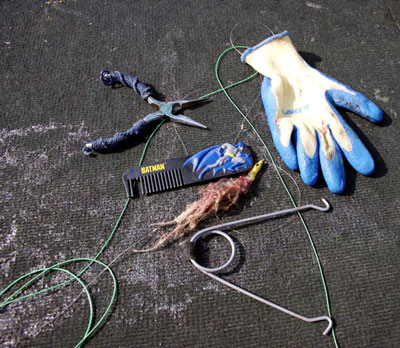
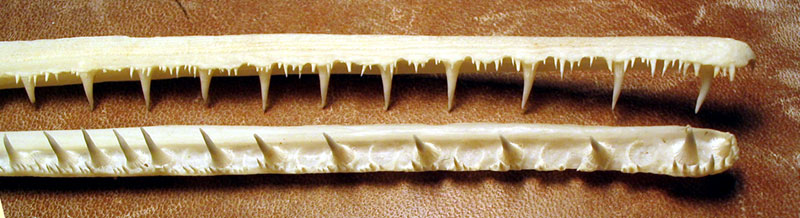
Removing the fly from the fish may be the hardest part of the whole proposition. You'll need something to hold his mouth open and a stiff brush to pull the fibers from his teeth. A glove or a towel will help you hold the fish - the scales can cut and the fish is very slick and very strong. Note the teeth - hundreds of them & very sharp - I suggest a sturdy glove. I like a big screw-driver and a jaw-jack designed for pike and musky. Some anglers use a home-made wooden jig to hold the mouth open. Regardless, maintain a firm hold on the fish throughout - they'll "play possum" and then explode when you least expect. The fly will be a tangled mess - no problem, just comb it out a little and it'll still work just fine.
Eating Gar There are those who claim gar is quite good to eat ("tastes like chicken," right). I am in no position to debate the point as I've never tried. The instructions for cleaning given on a website somewhere suggest a big axe and a bandsaw for prepping the fish - I don't have a bandsaw.
|
| C o n t a c t K e n t at kent@flyfishga.com or 7 0 6 - 8 8 1 - 3 2 4 9. |